Talking Myths - An online archive of traditional tales from Indian subcontinent
  • Home
  • About Us
    • About Talking Myths Project
    • Team Talking Myths
    • Contributors
    • Associates
  • Archives
    • Categories
      • Folktales
        • Folktales from Mahabharata
        • Folktales from Ramayana
      • Myth
      • Legend
      • Beliefs and Traditions
      • Taboo
      • Didactic Tales
        • Fables
        • Jataka Tales
        • Panchtantra
  • Share a Story
    • Terms & Conditions
    • Upload Story
    • Submission Criteria
  • Index
    • Source
    • Authors/Texts
    • Location
  • Lectures
  • Blog
  • Events
  • Contact Us
  • YouTube
Home
About Us
    About Talking Myths Project
    Team Talking Myths
    Contributors
    Associates
Archives
    Categories
    Folktales
    Folktales from Mahabharata
    Folktales from Ramayana
    Myth
    Legend
    Beliefs and Traditions
    Taboo
    Didactic Tales
    Fables
    Jataka Tales
    Panchtantra
Share a Story
    Terms & Conditions
    Upload Story
    Submission Criteria
Index
    Source
    Authors/Texts
    Location
Lectures
Blog
Events
Contact Us
YouTube
  • Home
  • About Us
    • About Talking Myths Project
    • Team Talking Myths
    • Contributors
    • Associates
  • Archives
    • Categories
      • Folktales
        • Folktales from Mahabharata
        • Folktales from Ramayana
      • Myth
      • Legend
      • Beliefs and Traditions
      • Taboo
      • Didactic Tales
        • Fables
        • Jataka Tales
        • Panchtantra
  • Share a Story
    • Terms & Conditions
    • Upload Story
    • Submission Criteria
  • Index
    • Source
    • Authors/Texts
    • Location
  • Lectures
  • Blog
  • Events
  • Contact Us
  • YouTube
Talking Myths - An online archive of traditional tales from Indian subcontinent
Folktale

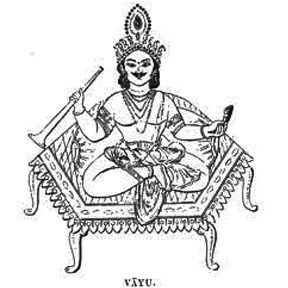
Vayu’s predicament

There is a myth, at least there was in the times gone by, when my mother was a girl. It is that women do not suffer from the curse of flatulence. She told me this story. In a Goan village, many years ago, folks lived in harmony. There lived amongst them two families who had two sons of marriageable ages. Both of them, it was said, were born on the same day, same time right down to the exact moment of birth. Duly, and dutifully too, their parents arranged their marriages. Their respective wives also had striking resemblance to one another. So striking was their likeness that newcomers to that village believed that they were sisters.

However, the outer similarities did not bespeak of their inner make up and their characters. While one was sweet, the other was bitter; one the very embodiment of womanhood, the other had flaws in her nature not quite in keeping with the norms of feminine temperament. But there was no discord between either because of or in spite of their contrasting natures. In fact, both the girls soon won the trust and affection of all elders in the village.

One day there was a function in one house hold. The newlywed bride (the sweet one) was so adept at all the household work that not only did she help arrangements but cooked, it was said, a meal most delicious. Just as the men folk were busy satiating their appetites, the girl had an irrepressible urge to release pent up intestinal gasses. The girl panicked, for to let go in a hall full of people, all men at that, was the most horrifying predicament. She excused herself and rushed into the confines of a suitable antechamber, but alas! It was a tad late. All heard the most embarrassing sound enhanced by the concentrated quiet of the lunch hour and knew at once its producer. The poor girl ran right out of the dining hall through the passage out into the back yard where the well was. Not looking behind, she rushed on and jumped straight into the well overcome with shame.

In no time she drowned and her soul went directly to heaven. There, in heaven, Indra, the god of thunder was presiding. The celestial court was in session! The guards tried to hold the newly dead girl when she rushed to fall at the Gods lotus feet. The ensuing commotion interrupted the court proceedings. Looking at the lovely girl, puzzled by her young age, Indra asked Chitragupta, the Divine bookkeeper, the cause of her death. Chitragupta told Indra what had happened. He felt sorry that a young girl, in prime of her youth, was overcome with shame because of flatulence. He sent summons to the King of gas, Vayu who presented himself before Indra with folded hands. Indra, revealed the reason for his summons and ordered him never to inflict women. “From now on no woman will entertain you!” said Indra. Vayu accepted the command, and retreated with his Godly dignity.

Indra turned to the girl and smiled. “There!”, he said, :” From now on all women will live a long life bereft of the ignominy and shame of flatulence.” Then he called his treasurer, Kubera, and asked him to bedeck the girl with his priceless ‘abhushanas’ and asked Yama, Death, to bring her back to life and her homestead. Then he blessed the girl and bid her leave.

Down below, on earth, there was commotion near the well. The husband of the girl had jumped into the well. He had dived to look for her body many times but had failed. He dived again. This time, he touched something. So he quickly grabbed it. It was her arm and he pulled her out. The girl was resuscitated and brought home to rest after this tense incident.

Next morning, as though nothing at all had happened, the girl set about her chores. She went to the well to fetch water. There, all the women had gathered. They were restive, dying to know how the girl had managed to not only survive, but how she had come up with such exquisite ornaments of diamonds and gold. They had noticed the dangling diamonds dazzling her face. They all rushed to her with the other girl leading (the bitter one). She was the most curious of them all!

“What happened? Where did you get this? Is there gold at the bottom of the well? – There was a barrage of questions from the curious ladies.The girl calmly told her unbelievable story. No one believed her. They thought that the girl was fibbing in order to avoid telling them the truth. No one believed her, except her neighbour. They both knew each other well enough to know when the other was telling a lie.
After filling their pots the women dispersed. The other girl was thoughtful. She also wanted the diamonds and decided upon a plan. Soon enough an opportunity presented itself. The girl cooked many dishes, all with gas inducing ingredients. Before lunch the girl, with the pretext of tasting the dishes consumed much food. Her belly was tight! She tried hard to release the gas, but in vain! She ate more, and more; tried harder. She kept on trying to fart but it was not to be.

Vayu was a faithful ally of Indra, the king of gods. The girl was getting sadder by the minute, but something happened. Just as she bent to serve her father-in-law, a faintest of farts escaped her. She was elated! She rushed to the well and jumped. She died instantly. Yama’s aides were waiting for her. They escorted her to Indra’s court. Before Indra could ask, the girl putting on a great show of shame and grief told Indra why she had committed suicide at such a young age. He sent for Vayu. His guards returned with the news that Vayu was hospitalized with high fever and inexplicable but severe injuries to his whole body. Indra arranged to visit him with his retinue accompanying him and the girl. Vayu looked very badly hurt. Indra, moved to pity restored Vayu to some semblance of health and asked him what the reason was for breaching his trust.

Vayu sat up with difficulty and told Indra how the girl had coerced him. He told how he had resisted, pointing to his wounds and sobbed uncontrollably. Indra put his hand on Vayu and restored him to full health. They returned to court. He called in Kuber and fired an angry order, “Go at once and fashion ornaments in lead and iron. Don’t waste time designing things of beauty. A token embellishment would do fine!”

When heavy ornaments in lead and iron were brought to court and the girl bedecked with them, Indra said, “Go now back to mortality and toil there till such a time as death does not relieve you!” Quietly Indra’s guard accompanied the girl, deep into the cold waters of the well in the village.

Indra revoked the orders given to Vayu and said, Vayu, my dear friend and ally; I am pleased with your devotion. From today you are free to inflict any stomach that you deem worthy of your grace!” Vayu smiled at his Divine master. He saluted Indra and took his leave.

STORY COLLECTED BY: Charudatta Prabhudesai
STORY TOLD BY- Heard from the locals
LOCATION: Goa
IMAGE DETAILS: Wikipedia

June 1, 2015by admin
FacebookTwitterPinterestGoogle +Stumbleupon
Taboo

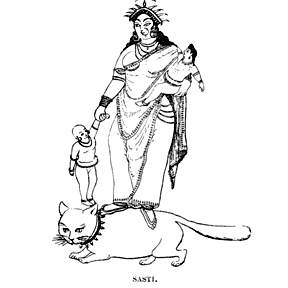
Shashthi and her cat

Satti, Shati or Shashthi, is a goddess propitiated on the sixth day of the birth of a child in Goa, a small state on the western coast of India. It is believed if she is not propitiated appropriately she can harm a newborn child and the mother, even causing their death. Shashthi generally afflicts newbornchild and the mother in form of puerperal fever. Hence she needs to be pleased.*
According to common lore,a daughter in law stolesome food from her father-in-law’s home. Afraid of being humiliated by her in laws, she blamed it on a black cat, who was duly punished for stealing. Incidentally the cat was the vahanaof Satvai CHECK. The cat decided to take revenge for being wrongly accused and started stealing her children as soon as they were born. Cat would take away her children and give it to Satvai. She thus stole six of her sons. When the daughter in law realisedwhat was happening, she prayed to goddess Satvai and asked for forgiveness. Satvaithen advised the daughter in law to sculpt acat out of rice flour and tie this to theimage of the goddess with a sacred thread andworship both. Once the child is born the sacred thread should be tied to the new-born baby as a sign ofprotection of Satvai. This should be done with a vrata or a vow, whereby the new mother should keep a fast on the sixth day by drinking only milk and fruits.
It is also believed that Satti visits new born child on sixth day and writes his/her destiny on her forehead. A midwife (voizin) generally conducts the ritual of Satti on the sixth day of birth of newborn baby. A winnowing fan is placed in the chamber of the new mother. Rice, coconuts, betel leaves, betelnut, flowers, vermillion powder, lampblack and turmeric are placed uponthe winnowing fan. An oil lamp is lit for entire night. Women of the family sometimes play games like fugadi. And conch and empty vessels are blown to drive away the evil spirits. The purpose of these festivities is to keep the child awake through the night when Satti comes visiting to write his fate. It is believed that death follows Satvai and if he sees a sleeping baby then he may snatch him away.
———————————–
*Over time, the characterizations of Shashthi underwent a gradual evolution. Aforementioned folk traditions originating between the 10th and 5th centuries BCE associated the goddess with both positive and negative elements of fertility, birth, motherhood and childhood. However, between the 4th century BCE and the 5th century CE, a shift occurred in which Shashthi was increasingly depicted as a malevolent deity associated with the sufferings of mothers and children. The fifth century text KashyapaSamhita calls Shashthi by the epithet Jataharini (“one who steals the born”) and provides a list of the malevolent activities in which Shashthi is believed to engage, including her practice of stealing fetuses from the womb and devouring children on the sixth day following birth. For this reason, the text recommends that she be propitiated through worship in her honor on this day in the delivery room and on the sixth day of every fortnight thereafter.
Over the past 1500 years, the characterization of Shashthi gradually shifted toward that of a benevolent and protective figure. Shashthi’s evolution mirrors that of the demonessJaraof the Mahabharataand a similar Buddhist goddess, Hariti all of them are characterized in early texts as malevolent goddesses, but over the course of time these deities transformed from devourers of children into their saviors and protectors.

http://en.wikipedia.org/wiki/Shashthi
Story collected by: Dr. PandurangPhaldesai
Text Source: Goa: Folklore Studies by Dr. PandurangPhaldesai
Location : Goa

May 1, 2015by admin
FacebookTwitterPinterestGoogle +Stumbleupon
Blog

Remembering Manasa on Womens Day

On Women’s Day today, there is the usual outpouring of celebratory messages, whether on the Google doodle or on Facebook or on chain SMSes etc…. The world is saluting our gender’s strength, creativity, compassion, fortitude – but, as in any other narrative on women, I struggle to find any references to a woman’s ambition that is unconditionally laudatory, without any undertones of prejudice or censure. So even today as speculation is rife on whether Hillary Clinton will run for the US Presidential elections or on the various headline-grabbing references to Anushka Sharma being the most stunning WAG for the men in Blue (never mind that she is a very successful professional in her own right), the discourse on women can never be conducted with focus on her ambitions, her goals alone! Probably the only woman in the public sphere who has succeeded in transcending this “trap” is “Didi” or West Bengal’s Mamata Banerjee. Much as I disagree almost entirely with her politics, I have to admire her drive and ambition that saw her realize power on her own terms in a country where women ascend to the “throne” only on the strength of dynasty or marriage or patronage from powerful men (like Jayalalitha or Mayawati). And I wonder if it’s pure chance in the universe’s systemic chaos or whether there is a socio-cultural and regional pattern that enables this singular expression of femininity in my home province. For, surely, one of the most unusual and arresting mythic personas from the countless myths and legends of India, is that of Manasa,the “Snake Goddess” of Bengal..an almost unparalleled mythic expression of an “anti-establishment” feminist ambition and power!

I remember reading, with a mixture of fascination and curiosity, many tales in Bengali about Manasa and her epic rivalry with Chand Saudagar. The latter epitomized patriarchy- a merchant prince, who had the power of his gender, of capital and patronage from the most powerful male deity of all, Lord Shiva. Manasa, on the other hand, was a lone “woman” who had command over the netherworld of snakes and serpents and her own unbridled ambition, and with these resources, she waged a relentless campaign for respect and recognition. Somehow even as a child, I realized that in the many versions of this tale that I read, there was always an overt and in some, a subtle tone in the writing, that underscored Manasa’s cunning, her rage, her ambition in a less than empathetic way. The final straw in the narrative is the introduction of Behula- the archetypical “Sanskritized” feminine role model- a woman who will sacrifice everything, including her life, to resurrect her husband, because she becomes significant only as a wife. As long as the myth is a rollicking adventure chronicling the tempestuous turns of the struggle between Chand and Manasa, the audience can still choose to take sides! But, the masterstroke of the patriarchy is to bring in the pathos of Behula-Lokhnidor and no wonder, audience sympathy will then be forced away from Manasa to Behula!

However, it may be topical today as debate rages on in India about women’s security and entrenched patriarchal violence against women, to remember and understand Manasa as a genuine feminist icon. Her myth signifies many anti-establishment profiles:

• A non-Aryan , lower socio-economic class cult struggling for patronage from people while up against upper caste Brahminical prejudices
• A semi-divine female confronting the established patriarchy, be it the divine Lord Shiva or the temporal capitalist authority of Chand Saudagar.

Manasa raises uncomfortable questions on the role of feminine energy when faced with male power and authority. From her birth ,Manasa has had to battle for her dues- Shiva first refused to recognize her ,though she is said to have been fashioned out of his seed! She is a great source of energy, but unlike the Sanskrit Mother Goddesses, Manasa’s power has a sharp, vindictive edge! She does not hesitate to resort to trickery, coercion or brute strength to subvert her enemies. And if that is par for the course and praiseworthy attributes of the great patriarchal male heroes of our Puranas and epics, then why not laud the same in Manasa too?

And the most significant aspect of Manasa, that I personally feel is worth celebrating, nay, even passing on to India’s Daughters today is that Feminine Spirit and Energy ,which is not shy of pursuing self-interest and ambition even at the risk of being deemed too aggressive or unfeminine!

So on this March 8, as one of India’s most talented sports icons, Saina Nehwal (who has always demanded to be judged just as an athlete not as a woman athlete), faces a great challenge at All England Open tournament, I say to my daughter and all her friends- go forward, find your goal and unabashedly pursue it and disdainfully ignore those carping voices who think there should be boundaries and limits and curfews and codes to transcribe a woman’s ambition!

RUKMINI GUPTE

March 1, 2015by admin
FacebookTwitterPinterestGoogle +Stumbleupon
Blog

Gods and Demons

With the Navaratri, Debi Paksha and Durga puja festivities coming to a close, people across India are celebrating the victory of good over evil. But I couldn’t help pondering about what would the goddess be without a demon to slay? What would Ramayana be without Ravana, or the Pandavas without the Kauravas, or Bhakta Prahlad without Hiranyakashipu and one can go on. Mythology is replete with stories about gods and demons in conflict, where the demons represent evil, epitomise malice, mischief, malevolence and every form of wickedness and the god or the goddess, stands for good slays the demon and reinstates social order.

Mythology we must remember is the science of primitive man; it was his manner of explaining the universe. And right from the beginning of time man was intrigued by the existence of the opposite forces – of good and evil, life and death, darkness and light, heat and cold, rain and sunshine, and the eternal struggle and dynamics that exist between these polar opposites. These forces and related phenomena took anthropomorphic forms, the benefactors or beneficiary forces as gods and goddesses and the rest, became demonic powers. (Of course, quite often, a present day god has begun his or her life as a destructive force. Prayer was an act of propitiation to start with, before it became a form of obeisance).

Demons challenge the existence of gods and humans alike. Human inability to comprehend and control these forces led them to create myths of supernatural power, trickery and magic and thus demon loosely started representing forces beyond human control and comprehension, one who has control over the negative aspects of the both material and spiritual world.

Demonisation also gained currency as nomadic Aryans marched into the subcontinent and found indigenous tribes with customs and practices very different from their own. The Aryans had to fight them to establish their relative superiority and to survive in a foreign land. And as indigenous tribes came to be known as Dasa, Dasyus, Danava, Asuras, leaders of the winning team were deified.

But an important facet of the gods and demons conflict is that they are always seen as equals, born from the same mother. They are both sons of Prajapati. Demons are often learned and worshipful even of the gods (Ravana an ardent devotee of Shiva) and they are also the recipients of boons of immortality or invincibility which leads them astray and becomes the cause of their downfall.

The battle between the two is also seen in myths as a battle between dharma and adharma. Durga slaying Mahisasura, Indra versus Vritra, Rama Versus Ravana, Krishna versus Kamsa, these are all instances of the triumph of the right order over the wrong one. But could we ever bring forth goodness without contrasting it with an opposing evil? Good in the universe is valuable only when it co-exists with evil; goodness on its own purposeless.

Gods and demons, good and evil are interdependent as are creation and destruction, light and darkness, life and death, they are not mutually exclusive but inclusive and one without the other is incomplete, the missing half of a whole. The battle fought between the Gods and demons is a quest to resolve tension of opposing forces, with opposing claims and interests and above all, the struggle for survival, an effort to achieve an ideal order, dharma. As a hero needs a villain, gods need demons as there would be no gods without demons, no one to save the world from evil forces and bring equanimity.

RUKMINI GUPTE

March 1, 2015by admin
FacebookTwitterPinterestGoogle +Stumbleupon
Folktale

THE FOREST OF FEAR

The ‘Stri parva’ section of the Mahabharata narrates a story. In the story a Brahmin was journeying on foot, he comes to an impenetrable forest that scares him to death because it was teeming with huge, carnivorous beasts. Horrible, voracious beasts were scattered on every side, such as lions, tigers and elephants. When he saw this, his heart pounded wildly; his hair bristled and stood straight up. Running through the wood, dashing this way and that, looking out in every direction, he wondered, “Where can I take refuge?”. He searched for some opening among those beasts; racing forward in terror but, he could not get out, and he could not get far enough from the beasts. In some time he saw that horrible wood was surrounded by a net on every side, and that an absolutely horrible woman had embraced the wood with her arms. The large wood was dotted here and there with five headed snakes, lofty mountains that touched the sky like tall trees.
In the midst of that wood there was a covered up well; its opening was choked with vines that were hidden under the covering of grass. The Brahmin fell into that hidden well and got caught in the webbing of the vine’s filament. He hung there with his feet up and head down, like a big jack fruit hanging by the stalk. And then another calamity made things worse. He saw a large, black brindled elephant at the edge of the top of the wall. It had six faces and moved on twelve feet and it was gradually working its way over the well, which was covered by vines and trees. As the Brahmin clung to the branch of tree, at its end there were all sorts of frightening, horrible looking bees; they had gathered honey and were returning to their hive. Honey is the sweetest of all things…….A stream of this honey was flowing there constantly and copiously, and that man hanging there drank from that stream. But in this dire situation, as he drank it, his craving did not abate. Never satisfied, he kept wanting it again and again. And the man never lost hope for his life….though white and black rats were cutting at the root of the tree on which his hope of survival depended!
He was afraid of the wild animals on the periphery of the impenetrable wood, of the extremely ferocious woman, of the snake below him in the well, of the elephant at the rim of the well, and fifth, he was afraid that the tree might fall because of the rats. There was also fear of bees that were greedy for the honey.
This story is told by Vidura to Dhrtarastra. Dhrtarastra was not only physically blind, but is also blinded by the affection for his sons. After narrating the story, Vidura explains that this is an allegory of human existence. The impenetrable wood is the mystery of rebirth. From which it is difficult to get away. The wild beasts are mental and physical diseases that frighten men, the gigantic woman is decay of old age that destroys one’s beauty, and the well is human body in which the soul hangs. The great snake at the bottom of the well is all devouring time, which takes everything away from human beings. And the vine and plant that grew across the middle of the well are desires of the embodied soul to stay alive. The huge elephant moving around the mouth of the well is a year, his six mouths are six seasons and twelve feet are twelve months. The rats that were cutting down at the root of the tree were days and nights, the bees are numerous desires for pleasure and trickling honey is sweet juice of pleasure in which men drown.
This story presents a very grim picture of human existence. But forgetting the inevitability of the diseases, crippling old age and ultimate destruction of human body, we occupy ourselves in accumulating riches, which we may never enjoy. Like the man who is surrounded by dangers from all sides forgets the imminent threat and fragile existence of human being and enjoys the pleasure of drinking the trickling honey. Similarly the soul in human body is deluded by the desire of pleasure.
Story collected by: Dr Ravi Khangai
Source: Mahabharata
Location: pan India

Dr. Ravi Khangai, Assistant Professor, Department of History, Rashtrasant Tukadoji Maharaj Nagpur University, India.

February 1, 2015by admin
FacebookTwitterPinterestGoogle +Stumbleupon
Myth

Shiva’s Bride

This is a temple tale from Madurai which explains how Minakshi the supreme goddess of Madurai fell in love with Lord Shiva.
The King of Madurai was childless and was distraught worrying about his successor to the throne. After much deliberation his priests advised him to perform one hundred horse sacrifices (asvamedha-s ) to gain highest spiritual merit or punya which would enable him attain a son as heir to the throne.
When he had completed successfully the ninety ninth sacrifice, Indra the Lord of heavens got alarmed. As he knew the hundredth sacrifice would dislodge him from his position of ruler of heavens, Indra appeared before the King and told him to perform instead the sacrifice of putra kameshti to obtain a son. The King took the advice and offered the sacrifice as per the rules, but to the amazement of all, a girl with a three breasts was born.
The King was troubled as he wondered how a girl with three breasts would carry on his legacy and rule the land? . Just then, a voice from the heaven advised him“ Oh pious King do not worry. Bring her up like a son. Teach her all the skills that are expected of a prince. When she meets the appropriate suitor, her third breast would disappear.”
Reassured by divine voice, the king named her Minakshi as she had the most beautiful eyes, like a pair of fish (mina= fish. aska= eyes). He brought her up like a son and taught her all the skills of a warrior. When the king died she ascended to the thrown. Minakshi- the princess was a fierce warrior and enemies feared her valor . No king could match her brevity and skills in war. Soon she set out to conquer the world.
In no time her army reached Kailasa and confronted the armies of Shiva. Shiva’s army were no match to Minakshi’s troops and began to loose the battle. Finally Shiva took to the battle field. A fierce battle broke out and Minakshi and Shiva came face to face. The moment she saw Shiva, she was transfixed and fell in love with the man before her. As the heavenly voice had predicted her third breast disappeared and Minakshi was overcome with modesty, innocence and shyness. The king’s advisor who had accompanied Minakshi immediately recognized that the prediction had come true. He approached Minakshi and said “Princess ! This man is your bridegroom” and explained to her the story of her birth.
Princess took Shiva to Madurai and married him in a grand ceremony. There Shiva reigned as Cuntarapantiya and ruled the land.

Story collected by : Vidya Kamat
Text source: Tamil Temple Myths, by David Dean Shulman, Princeton University, 1980
Location: Tamil Nadu
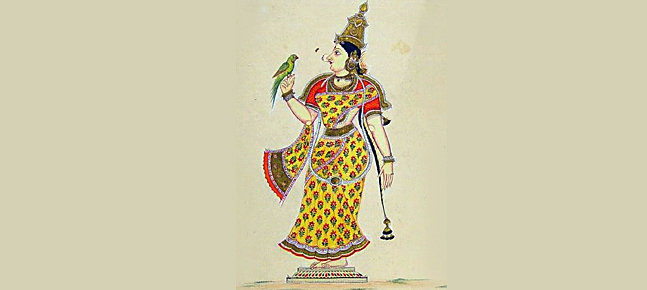
Image Details: Goddess Minakshi .
“Painting of the goddess Minaksi. She is depicted crowned, two-armed and with a green parrot perching on her right hand. An impression of perspective is provided by a lightly sketched in foreground. On-laid European paper watermark shows an armorial design and the letters ‘W T’.”
Artist : unknown
Image Source: Wikipedia

February 1, 2015by admin
FacebookTwitterPinterestGoogle +Stumbleupon
Myth

The fruit of Shabari

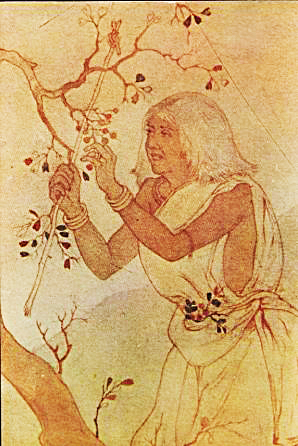
The incident of Shabari in the epic Rāmāyana which I have chosen to illustrate here occurs during the course of the 14 years of Rama’s exile to the forest. Shabari, a tribal, Bhil woman, has been a devotee of Rāma over a number of years. In her heart, Rāma is constantly present and her most ardent desire is to meet him someday in person. Now, she is old, her hair is all white, but her devotion to Rāma is as young as ever.

One day, she hears that Rāma is likely to pass through the village where she lives. And this excites her no end. She can neither eat, drink nor sleep. Her mind is effused with the thought that she will finally see the delight of her soul, her beloved Rāma. She turns into a bundle of eager anticipation. Suddenly it strikes her that when Rāma truly does come, what in the world will she offer him? She would certainly want to welcome him with some offering, but what? She neither has wealth nor possessions and nothing that would be worthy of being offered to, Rāma. Just then her eyes fall on the ripe, juicy berries hanging on the tree before her and she is inspired! She runs to the trees and begins plucking the fruit. But, what if they are sour, her mind whispers. What if appearances are deceptive and they turn out to be rotten from the inside? That would never do! And she begins to bite into and taste each berry. She throws the ones not fit to be offered and keeps aside the ones which are as sweet and pure as nectar. Now she is at peace—she can now be sure that when Rāma partakes of her offering he will receive the best there is!

And Rāma comes. She offers him the half-bitten and from our point of view, infected and soiled berries. It does not take long for Rāma to see through these half-eaten berries straight to the intention of Shabari. He realises the essence of her offering: Shabari’s total absorption in her devotion to himself. And he begins to savour them, one by one, with great relish. Laxmana is shocked. He is outraged with Shabari’s effrontery and then to witness Rāma enjoying the fruits with such relish!. Rāma then enlightens him, makes him see the ‘bhāva’, the sentiment behind Shabari’s action and clears Laxmana’s confusion.

Comment: The intention of the poet seer behind this little episode is to create an appropriate body, or form through words, sound, rhythm and meter; a form which is capable of carrying the intended content and reaching it to the depths of the listener. The content, if we summarize it, is the nature of the devotion which pervades Shabari’s state of being, the oneness in body, mind and spirit which she has been able to achieve with Rāma. She no longer sees her own self and that of Rāma as separate, they have overlapped. No discrimination or distinction remains, no boundaries divide into I and You. And because this has happened, the only way for her to be absolutely sure of the worthiness of her offering is to taste the fruits herself. The nature of the content is the nature of love, one of the manifestations of love.

Location: Pan India
Story collected by: Bharti Kapadia
Story told by: Grandmother
Image credit: Wikimedia Commons
Devotee Sabari offering fruits to Lord Rama (Statues at Simhachalam, Andhra Pradesh)

January 1, 2015by admin
FacebookTwitterPinterestGoogle +Stumbleupon
Folktale

The Lullaby

Once a girl was born with a curse that she would marry her own son. As soon as she hears the curse, she vows to escape the fate by secluding herself in the dense forest, eating only fruits and foreswearing all male company. But when she attains puberty, as fate would have it, she eats a mango from a tree under which a passing king has urinated. The mango impregnates her; bewildered, she gives birth to a male child; she wraps the baby in a piece of her sari and throws him into a nearby stream. The child is picked up by a childless king of the next kingdom, and brings him up as a handsome young adventurous prince. One day the young prince comes hunting in the same jungle where the cursed woman lives. They fall in love. She tells herself her son is longer alive and she can marry the boy she is in love with. She marries him and bears his child. According to the custom, the father’s swaddling clothes are preserved and brought out for the new born son. When the prince’s swaddling clothes brought out she recognizes her sari, with which she had swaddled her first son, now her husband and understands her fate had really caught up with her.
She waits till everyone is asleep and sings her lullaby to her new born baby:
Sleep
O Son
O grandson
O brother to my husband
Sleep o sleep
Sleep well
She then hangs herself by the sari twisted into a rope.

—————————-

Story collected by : Vidya kamat

Location: Karnataka
Source: “The Indian Oedipus” (pp109-136),  by A. K. Ramanujan, Vishnu on Freud’s Desk. Ed by J. Kripal, & T. G Vaidyanathan, Oxford University Press, 1999

January 1, 2015by admin
FacebookTwitterPinterestGoogle +Stumbleupon
Blog

So She Danced to Kill

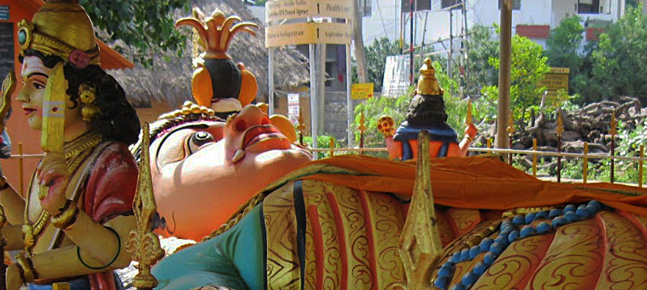
A few kilometers before Auroville, between the spiritual vibes and the foreigner-made Goa feel there is a small village with no significant name of its own. Perhaps as a visitor I have not cared to look for the name of the village. But by the side of a sharp turn in the road, I notice this small temple with a lot of idols. They cannot be missed because like in many Tamil Nadu temples, these idols also are painted in enamel colours. These anthropomorphic images are highly impressive with their rose bodies and multi-coloured costumes. I could have regarded this as one of those temples and invested my gaze into the silent wonders of nature around. But what attracts me is the main idol that lies down on the ground under a canopy, with guarding votive figures around it.

By the time I could take the details in my car has crossed the temple. Hence, while coming back I ask the driver to stop at the temple. I get down with my small camera and walk into the premises. I am very impressed by what I have seen there.

The signboard done in flex board says that it is ‘Arassummoottil Sree Ankala Parameshwari Amman Aalayam’. I look at the main idol that lies on the floor. It is the idol of a goddess and I recognize her as a Devi figure. Later researches prove that she is one of forms of Parvati worshipped in the Southern part of India. She is called Ankala Parameshwari. Ankala means Universe. This goddess who rules the universe. And she is in a relaxing posture after she danced to kill. According to the myth of Ankalamman it is said, once five headed Brahma performed a yagna to save men from two demons Sandobi and Sundaran. From the fires of yagna came Tillotama, an apasara who mesmerized the two demons by her beauty. To save herself from the clutches of two demons Tillottama fled towards Kailasa, followed by two demons and Brahma. When Parvati saw Brahma with five heads she mistook him for Shiva and feel at his feet. But when she realized the truth she was angry and prayed to Shiva asking him to destroy Brahma’s fifth head. Thus Shiva assumed the form of Rudra and beheaded Brahma’s fifth head.

Angry and humiliated Brahma cursed Shiva that his head would get attached to his hand and thereby Shiva would be affected by hunger and lack of sleep. Shiva as Kapalika- i.e. one with skull in hand, roamed the earth, slept in graveyards and smeared ashes over his body and started begging for food. Whatever food he would get the skull or Kapala began to eat most of it. Meanwhile Parvati was unable to bear her husband’s misery. She approached her brother Lord Vishnu and pleaded him to relieve Shiva from Kapala. Lord Visnu told her, “My dear sister, go to Thandakarunyam graveyard with your husband and make a pond there and name it “Agni Kula Teertham” then prepare a tasty food made by “Agathi Keerai” mix it with the blood and spread that food around the graveyard. With the smell of blood, Kapala would leave Shiva’s hand and eat the food. Then take your husband to the pond and wash him clean with waters so that Kapala would not get stuck to his hands again.”. Parvati did as her brother said and when Kapala got detached from Shiva’s palms she cleaned him with the water. When Kapala came back to Shiva it could attach itself, but now it attached itself to Parvati hand. She became so furious with anger and began to dance. As she danced she grew in size. bigger and bigger till she covered the universe. In this gigantic form she crushed the Kapala with her right foot. Only then she lay down to relax on the ground to relax.

In this fiercest form which destroyed Kapala, and which came out of Parvati is called Ankala Parmeshvari or more fondly as Angalaamman. Parvati then asked Angalaamman to stay in the same place and serve the people.

Ankala Parameshwari is worshipped in different parts of Tamil Nadu and Andhra Pradesh. In some places she is worshipped as a pregnant goddess. And most of the pregnant women from these regions travel to Ankala Parameshwari Amman Alayam for healthy children and painless delivery.

There is a beautiful mutative blend of Shaivite and Vaishnavite cults in this temple. The guarding angles of Ankala Parameshwari are the incarnations of Vishnu. And interestingly most of them are in the female form. So you see a Narasimha moorty and Varaha in female forms. Even the mutations of the cults are shown in the Ardhanareeshwara.

This particular village temple is called Arasummoottil because there is an arasu tree in the premise. And one interesting idol that I find is a small sculpture of a tortoise kept under a tree. And before this tortoise figure there are a row of bricks kept vertically smeared with turmeric powder and kajal. There are yellow threads running around it.
Women constitute majority of devotees in this temple. What interests me is the celebration of femininity and feminine principle including pregnancy as a centre of worship in this temple. Without controversy the transformation of male incarnations are made into female incarnations. This I feel is like a reading of the male scriptures from a female point of view; a sort of discursive cult that challenges the male point of view without breaking much of the ideologies built around the Hindu temples.

 Story Collected by : Johny M L

Source: as told by locals

Location : Tamil Nadu

January 1, 2015by admin
FacebookTwitterPinterestGoogle +Stumbleupon
Myth

The Bear Of Jain Mountain

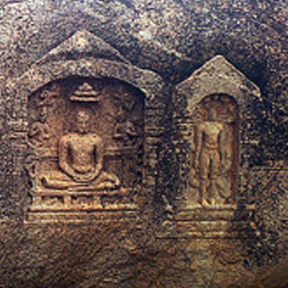
Near Madurai in Tamil Nadu, at the foothills of a mountain called Samanar Malai by the people who live there is a village called Nagamalai. The mountain is called thus because it houses many Jain caves and Samanar means Jain in Tamil. At the top of the mountain was a temple of Ayyanar Karuppannachami.

When the British ruled India, so the story goes, there was an army general who would regularly visit the famous Meenakshi temple of Madurai and insult the goddess. (There is no record of what he did that but there is unanimity in the belief that he did insult her.) This was unbearable for Karuppannachami. So every time the general made his way to the temple, he would knock him off his horse. Disturbed at this, the general consulted an astrologer who told him that this was being done by none other than Karuppanna Chami of Samanar Malai.

On the astrologer’s advice, the general whose name has been lost to history, brought Karuppannachami from the mountain and consecrated him near the Ayyanar temple in Nagamalai. No sooner than he did this, the problem disappeared. And a grateful general donated large amounts of land to the people who helped him do that.

Before bringing down Karuppannachami from the mountain, the Brahmins used to worship at the Ayyanar temple but afterwards the task was entrusted to the Velars. These people had to come through thick forest to reach this temple from their village Vilacheri and they believed that while walking to the temple from their villages and back, Karuppaannachami accompanied them in the form of a bear for their protection. The Velars gratefully named their children “Samanar Malai Karadi (The bear of the Jain mountain).
The village of Nagamalai however had other problems too. It along with its neighboring village of Keezh kuil kudi lay in a barren area. Famine forced its people to go to other villages for jobs. Two residents of these villages went to Karumathur and worked as priests at the Moonu Sami temple. After the famine when they were about to return , The gods Virumappa Chami and Kasi Mayan of Karumathur asked them to take one fist of mud from their temples to their villages. They took the mud and consecrated temples for these Gods near Karuppannachami of their village. They also consecrated Kazhuvanathan, Karuppayi Amman , Irulappan , Changili Karuppannachami etc as security gods.

Contributor’s bio.
P.R. Ramachander is a retired scientist. Apart from biometrics , he is interested in astrology, translating ancient scriptures to English, Hindu culture, and Story telling.

January 1, 2015by admin
FacebookTwitterPinterestGoogle +Stumbleupon
Page 14 of 16« First...10«13141516»

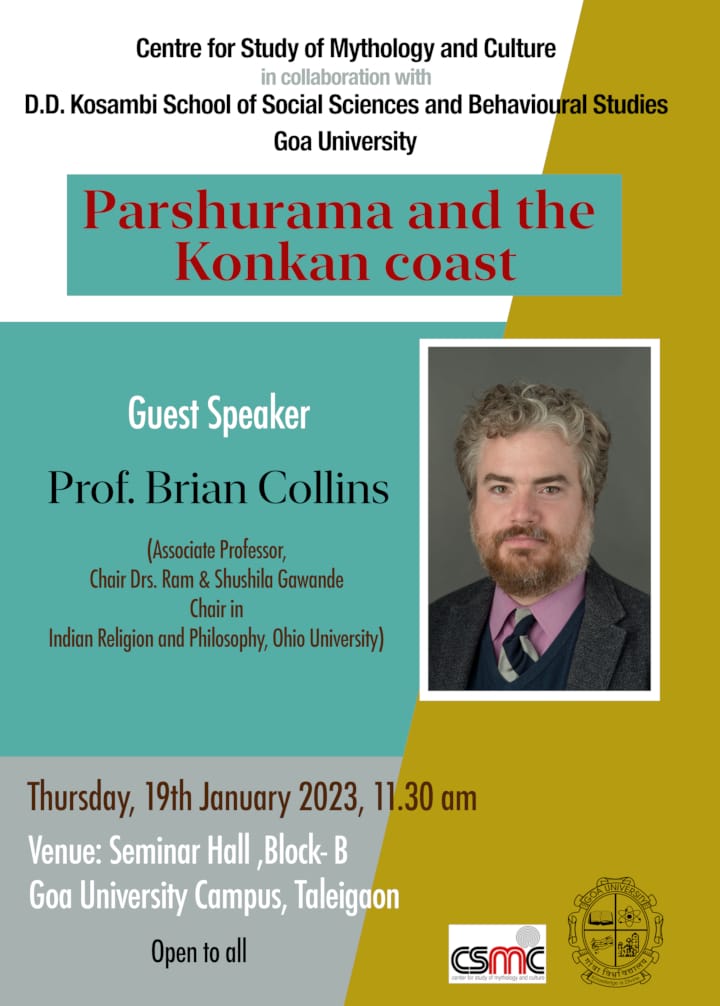
…Current Event…

JANUARY 19, 2023

….Recent events….

October-2022


September-2022


October-2021


A CSMC Initiative

"To tell a story is to discover or reveal a secret"- A.K.Ramanujan

© 2015 copyright Talking Myths  All rights reserved
Website Developed by Raj Trivedi